research
If you are interested in pursuing a Ph.D., please email me with your research interests.
Email: omprakash@iitd.ac.in
I focus on integrating machine learning techniques within process systems engineering (PSE). The following visualization illustrates the role of PSE:
Below are some of my works, highlighting areas of interest
Graph Neural Network Based Analytics
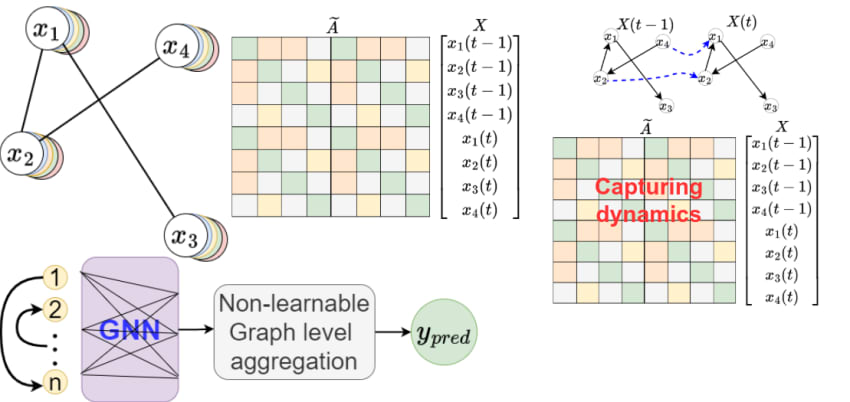
Graph Neural Networks (GNNs) provide a powerful framework for process analytics by capturing complex interdependencies among variables that traditional models often overlook. Our research develops graph-based soft sensing methods for quality prediction in nonlinear and dynamic chemical processes. We address challenges such as learning graph structures when they are not known a priori and mitigating non-injective aggregation issues that can obscure neighborhood information. To improve accuracy and interpretability, we integrate temporal dynamics and propose end-to-end frameworks that jointly learn graph structures and model parameters, enabling robust predictions in noisy industrial environments.
Modeling Dynamical System
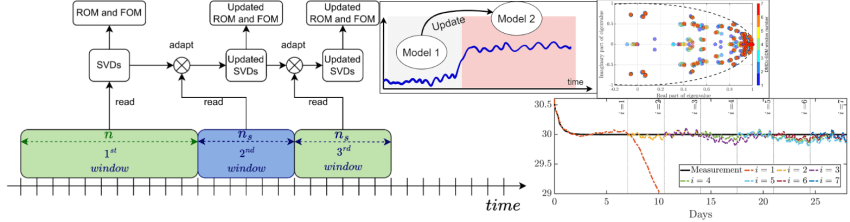
Dynamic processes in engineering and natural systems often involve complex, high-dimensional interactions that evolve over time. Data-driven modeling provides a powerful way to capture these dynamics for monitoring, estimation, control, and optimization. Our research focuses on developing techniques based on Koopman analysis and Dynamic Mode Decomposition (DMD) to identify both full-order and reduced-order models from process data. We also devise methods for real-time updates, enabling models to adapt to evolving process behavior. The updates rely on efficient Singular Value Decomposition (SVD) strategies. These approaches are applicable to a wide range of dynamical systems, from chemical processes to environmental and industrial systems, and are particularly suited for large-scale, real-time applications.
Sensor Placement Design (SPD)
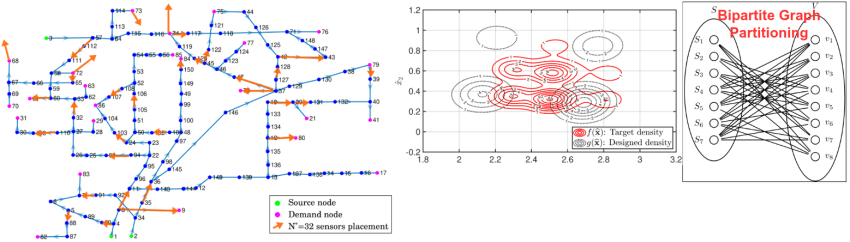
In the era of Industry 4.0, sensors generate vast amounts of critical process data, making optimal SPD an essential prerequisite for safer, more controlled, and efficient operations. We focus on designing SPD objectives using variance and reliability criteria for fault detection, diagnosis, and variable estimation. We developed measures that quantify system-wide behavior while allowing users to prioritize target system performance, unlike conventional approaches. Given that SPD is a combinatorial optimization, NP-hard problem, we design efficient solution strategies for SPD. Hypergraph partitioning further reduces computational complexity, making our approach scalable to large industrial systems.
Process Monitoring and Fault Detection
Fault detection is a critical requirement in industrial operations, where early identification of abnormal conditions ensures safety, reliability, and economic performance. Process data, however, is often noisy and requires effective preprocessing that integrates statistical techniques with domain knowledge, which is increasingly important not only for feature engineering but also for selecting appropriate hyperparameters. At the same time, supervised learning has shown promise; its dependence on large volumes of labeled fault data limits applicability in industrial settings, where such data are scarce. Simpler statistical models, e.g., Principal Component Analysis (PCA), play an important role due to their interpretability and ability to capture dominant process trends, making them valuable for real-world monitoring applications.
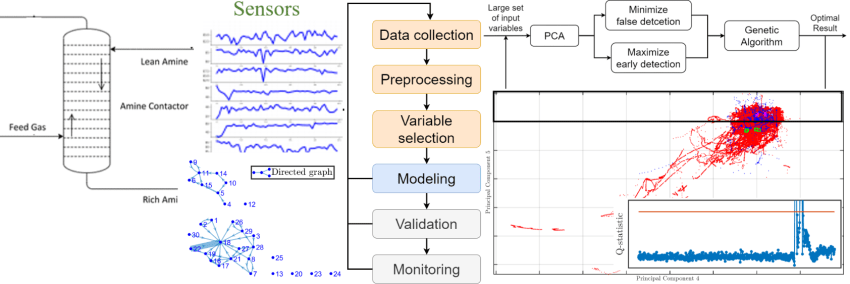
Image Processing Based Process Analytics
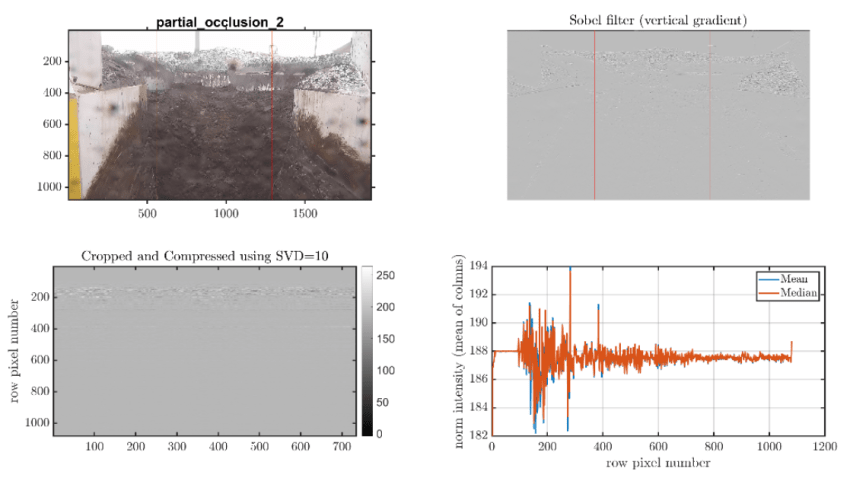
Images offer a non-invasive way to monitor processes, especially in situations where inserting sensors is challenging. From simple edge-detection methods like the Sobel filter to advanced convolutional neural networks (CNNs), a range of techniques can be applied to extract meaningful information.